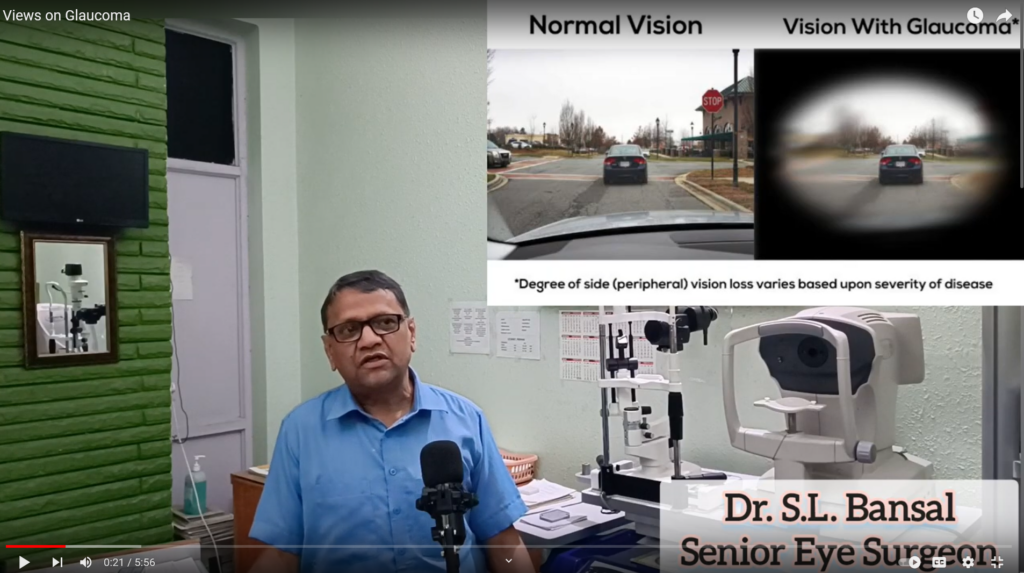
Click on the YouTube link below to watch “Views on Glaucoma” by Dr. S. L. Bansal, Bansal Eye Hospital, Yamunanagar-Jagadhri.
Hello friends, I am Dr. S.L. Bansal, eye specialist at Bansal Eye Hospital, Jagadhri, Haryana. Today I want to talk to you about glaucoma — what we commonly call kala motiya.
I want to start by being very clear about one thing: kala motiya is not just a name — it is a serious disease, and it needs to be treated with exactly that level of seriousness. Once glaucoma has taken away a certain amount of vision, getting that vision back is very difficult — almost impossible. Yes, we do operate on these eyes when needed, but the vision that is already lost does not return.
What Is Kala Motiya?
Glaucoma is simply another name for increased pressure inside the eye. Just as we have blood pressure in our body, our eyes also have their own internal pressure. Normally, I consider this to be somewhere between 10 and 21. When the pressure rises above 21, we call it glaucoma.
How I Diagnose Glaucoma
When you come to me, I don’t rely on just one measurement. I look at it from a few different angles:
- Increased eye pressure — measured using various machines.
- How much visual field has already been damaged — I check this through a field test.
- How weak your optic nerve has become — I assess this using OCT (a nerve-imaging test).
- I also use one or two additional tests, including one called gonioscopy.
Based on all of this, I decide on your treatment — usually starting with medication.
Once I Prescribe Medicine, This Is Your Responsibility
After the diagnosis, I explain the condition to you and prescribe medication. From that point on, it becomes your duty to follow that medication exactly as instructed. This means:
- Using the drops exactly as many times a day as I’ve told you — no more, no less.
- Using them at the specific times I’ve mentioned — whether that’s two times or three times a day.
- If I’ve told you a particular drop is only for nighttime use, please use it only at night.
Once I confirm your glaucoma diagnosis and prescribe medication, I will also tell you when to come back for a follow-up, on a specific date. It’s important that you keep that appointment. A day or two earlier or later isn’t a problem, but not following up properly — or coming back after six months instead — can seriously harm your vision.
How I Treat Glaucoma
Glaucoma treatment, in my experience, generally falls into three categories:
- Medication
- Laser treatment
- Surgery
With today’s advanced science, I rarely need to resort to surgery. Most of my patients are treated very effectively with medication and laser alone.
I want to repeat something important here: the vision that is lost to glaucoma does not come back. So please use your medication exactly as prescribed. And if, based on your gonioscopy results, I recommend laser treatment, please make sure you get it done.
A Practical Note on Eye Drops
Some glaucoma medications can be expensive — I’ve seen some cost as little as 6-7, while others, even in a small bottle, can cost as much as 900. Given this, when you put the drops in your eye, please do it in a way that doesn’t waste the medication:
- Lie down or tilt your head back while putting the drop in.
- Gently pull down your lower eyelid only slightly.
- Whoever is applying the drop should hold the lower eyelid down for about 10 seconds afterward.
- Please don’t blink rapidly right after putting the drop in — this can cause the medication to be wasted, which works against you.
Why I Keep Emphasizing This
I say this again and again because glaucoma is a condition that requires complete, ongoing commitment to treatment. It shouldn’t happen that I prescribe a medication, you buy one bottle, use it up, and then stop because you feel fine. That approach can be very harmful.
At the end of it all, I have to be honest with you: as your doctor, the only thing truly in my hands is controlling your eye pressure — and even that, I manage through two or three different methods. But I also need you to understand something important: even after your pressure is well controlled, the optic nerve — the nerve that carries light signals from your eye to your brain — can continue to weaken over time. In that situation, I have no option left except to strengthen it further with additional medication.
Once you understand all of this, I hope you’ll take glaucoma seriously going forward. Thank you.