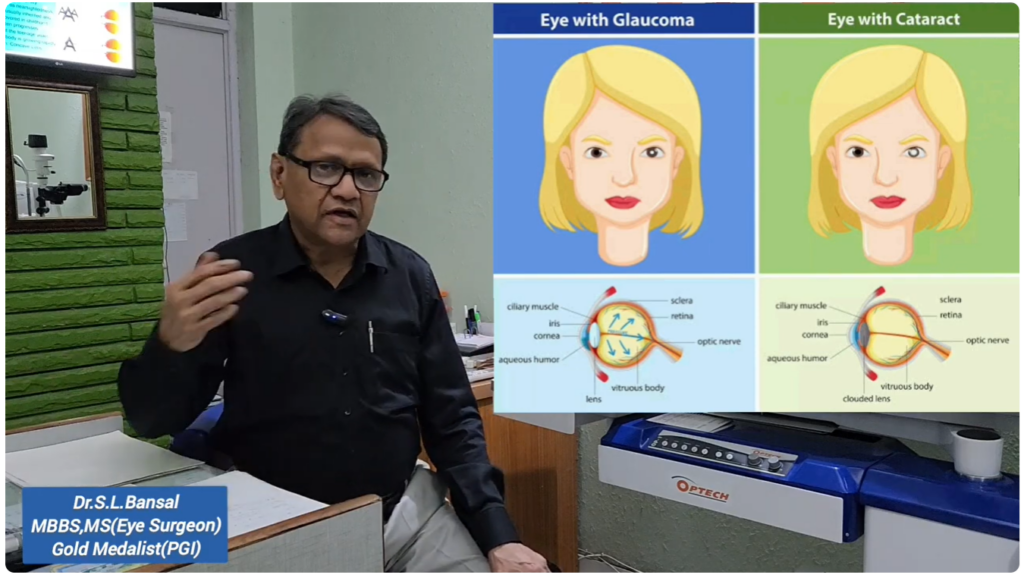
Click on the YouTube link above to watch “Views on Glaucoma – Part 2” by Dr. S. L. Bansal, Bansal Eye Hospital, Yamunanagar-Jagadhri.
Kala Motiya (Glaucoma): In My Own Words
I am Dr. S.L. Bansal, eye specialist, and today I want to talk to you about kala motiya — glaucoma. Most people have heard this name before. Let me start by clearing up something important: kala motiya is not the same as safed motiya (cataract). I want you to understand clearly that these are two completely different conditions. That said, it’s entirely possible for the same person to develop both — glaucoma first and cataract ten years later, or cataract first and glaucoma two years after that. Either order is possible, but they remain two distinct conditions.
What Is Kala Motiya?
Inside our eyes, a special fluid is constantly being produced — we call it aqueous humor. This fluid is also constantly draining out of the eye after doing its job, which is to nourish the parts of the eye it comes into contact with. Normally, this is a balanced process: as much fluid is produced as drains out.
Now, if for any reason the fluid isn’t draining out as quickly as it’s being produced, pressure builds up inside the eye. This, broadly speaking, is what I call glaucoma.
Why I Consider It a Dangerous Disease
I describe glaucoma as a very frightening disease, and I want to be specific about why: once vision is lost to glaucoma, it does not come back — no matter what we do. Operation, medication, laser — nothing will restore the vision that’s already gone. This is a huge loss, and it’s exactly why I tell every patient: the moment you’re diagnosed with glaucoma, you cannot ignore it, deny it, or delay treatment even for a moment. From that very moment, you must follow every single instruction I give you, word for word. If you don’t, whatever damage has already occurred stays permanent, and any further damage will fall into that same unrecoverable category.
Two Broad Types (Age-Related)
Glaucoma has many causes, but today I’m focusing on the type linked to age — it can appear at 40 in some people, at 55 or 70 in others. Beyond age-related causes, there are many other reasons glaucoma can occur, which is a much bigger conversation on its own.
For age-related glaucoma, I broadly divide it into two categories:
- Angle-closure glaucoma — where a specific angle inside the eye closes off.
- Open-angle glaucoma — where that angle remains open.
The treatment approach for these two is quite different:
- In angle-closure glaucoma, I usually start with laser, followed by medication.
- In open-angle glaucoma, I usually start with medication, with surgery coming later if needed.
The Three Pillars of My Treatment
Overall, I rely on three broad approaches for treating glaucoma:
- Medication — eye drops or oral tablets.
- Laser
- Surgery
What I Tell Every Patient About Their Medication
When I prescribe medication for glaucoma, I give very specific instructions along with it — things like: use this drop twice a day with a certain gap between doses, use this one only once a day, or come back for a check after 20 days so I can decide whether to continue or adjust the medication.
I’ll be honest with you — more than half of my patients don’t use these drops correctly. And many patients make the mistake of finishing one bottle of medicine and then simply stopping, thinking they’re done. What happens then is that glaucoma quietly starts doing its damage again. This is exactly why it’s so important to use the medication exactly as I’ve instructed — and to come back for the follow-up visit at the time I’ve specified, whether that’s 15 days or 20 days later.
Why I Repeat the Same Tests Again and Again
For glaucoma, the tests I run most often are:
- Checking eye pressure
- Field test (visual field)
- OCT
- Applanation tonometry (another way of checking eye pressure)
These same three or four tests get repeated over and over, and I want you to never hesitate when I ask you to repeat them. The reason is simple: I can only tell whether there’s been any further damage by comparing today’s test results with your previous ones. If there has been additional damage, I increase the medication. If increasing the medication doesn’t hold the pressure, then surgery becomes necessary.
My Bottom Line on Glaucoma
Everything I’ve said keeps bringing me back to the same point: don’t ignore glaucoma. Take it very seriously, and follow the treatment plan diligently. If you don’t, you will suffer the consequences. God forbid, if you lose vision to glaucoma, nothing can be done afterward — all you’ll be left with is regret, thinking “I should have taken the medication properly” or “I should have listened to what I was told.” At that point, that regret won’t help you at all. This is why I insist that glaucoma must be taken seriously.
There is one exception I make in my own practice: if I know a patient travels 50 kilometers to see me, is not well educated, has difficulty understanding instructions, or I sense they may not use the medication correctly — whether due to genuine difficulty or financial constraints — I don’t consider it wrong to recommend surgery for such a patient right from the start, rather than relying on medication compliance I’m not confident about.
With this, I’ll end today’s conversation. Thank you.